

A foreign investor who decides to open a company in Spain must decide upon the legal entity of the business he or she wishes to set up. Since Spain is a rather attractive jurisdiction for foreign investors, the entrepreneurs can choose between several business sectors, as well as types of companies.Our team of specialists in company registration in Spain can assist foreign investors with more details on the types of entities that can be registered here, which are presented in this article.
Table of Contents
What types of Spanish companies are available for incorporation?
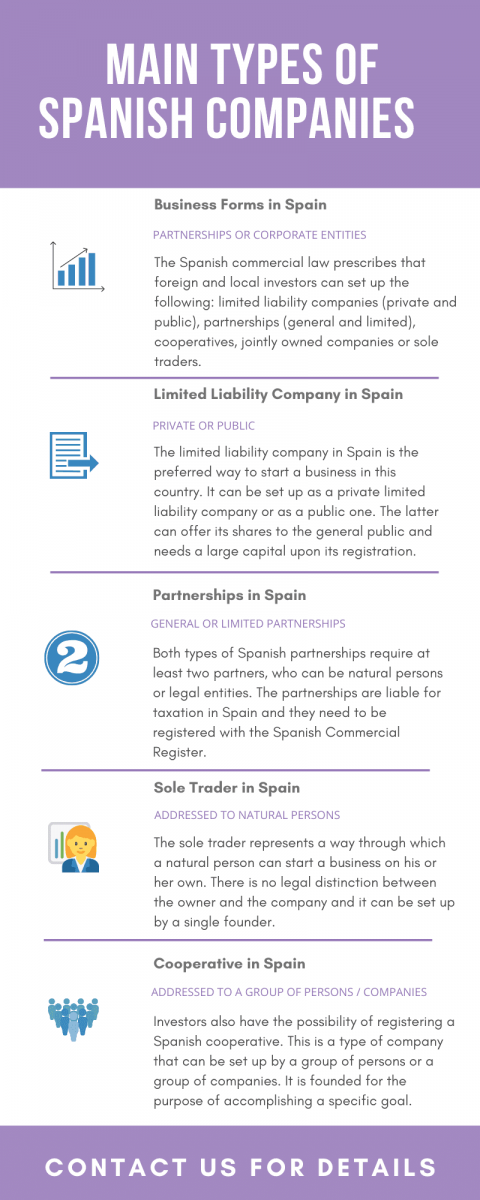
Foreign investors who want to start the procedure of company registration in Spain can choose from a wide range of legal entities, which are prescribed under the country’s national legislation. Our team of consultants can assist investors with advice on the characteristics of the following types of business forms:
- sole proprietorship – it represents the simplest way to start a business in Spain and this type of business form is addressed only to natural persons;
- jointly owned company – it is a business form that resembles to a wide degree with the sole trader, but the difference is that it can be set up by more natural persons;
- new enterprise limited company – it represents a simplified form of the limited liability company, which is presented in this article;
- cooperative – it can be set up by a group of natural persons or group of companies with the purpose of accomplishing a specific goal.
What is a private limited liability company in Spain?
Limited liability companies in Spain are the most popular companies chosen especially by foreign entrepreneurs due to their flexibility and simple registration procedures. The capital of this type of company in Spain is divided into shares and the shareholders are liable only to the extent of their contribution. It is important to mention that the shares cannot be freely transported and cannot be sold to the public.
What is the public limited liability company in Spain?
These are also known as joint stock companies (sociedad anonima) and they require at least one shareholder for company incorporation in Spain. At least EUR60,000 have to be provided for company formation in Spain and a quarter of this sum must be paid up before the registration. Members of the company are only liable to the extent of their own contributions. Our team of consultants in company formation in Spain can assist investors with more information on the procedure for opening this type of business form.
How to register a general partnership in Spain
The registration ofa partnership can be completed provided that if there are at least two members to associate in the business. The regulation is also applicable in the case of limited partnerships in Spain. Partners have all equal responsibilities and rights, since they have the quality of general partners. Under the local legislation, the partnership has to be registered with the Spanish Commercial Register. Its founders must also observe the rules related to VAT registration in Spain.
We can also help you with opening a bank account and accounting services in Spain. If you are interested in setting up a company in China we can put you in touch with our local partners.
How to register a limited partnership in Spain
At least two partners must agree on setting up a limited partnership in Spain, too. The shareholders can be individuals or legal entities, with no minimum share capital. At least one member is a general partner and at least one is a limited partner, with limited liability to the extent of their own contribution for company formation in Spain.
What are the characteristics of the sole trader in Spain?
If an entrepreneur decides to set up a company in Spain on his own, then it is the simplest way to establish a sole trader entity. No minimum share capital is required, but he is fully liable for the company’s obligations. No legal distinction is made between the sole trade entity and the owner under the Spanish law.
Below, investors can watch a video, presenting the main types of Spanish companies:
For details, you may contact our company formation agents in Spain. Our consultants can provide in-depth assistance on the registration of one of the above mentioned business forms; investors may also request advice on the taxes that are applicable to these entities and may also receive information on the accounting procedures available for a particular type of company. If you want to open a company in another country and you are interested in company incorporation in Malaysia, we can put you in touch with our local partners.